School Performance and Ofsted
OFSTED
The Office for Standards in Education (Ofsted) inspects schools to provide an independent assessment of the quality and standards of education in schools and check whether pupils are achieving as much as they can.
Blaby Stokes C of E Primary School was last inspected in April 2025. The report can be found below.
Parents and carers can share their views on our school by visiting the Parent View Website

School Performance
What are National Curriculum Tests?
SATS (which stands for Standard Assessment Tests) is the common name used for National Curriculum Tests. Children are assessed at the end of Year 6 (Key Stage 2) in reading, writing and maths. Key Stage 2 results are a combination of teacher assessment and externally-marked national tests. Year 6 children also have to take a Spelling, Grammar and Punctuation test (GaPS). Their writing level is decided by teacher assessment based on a combination of genres and a collection of writing pieces from the whole year.
Phonics: The children in Year 1 also have to take an external test for their phonics. They will be asked to read a list of words (some are real words, some are not) in order to assess how they apply their phonological knowledge.
Further information can be found at:
https://www.gov.uk/government/organisations/standards-and-testing-agency
FAQs
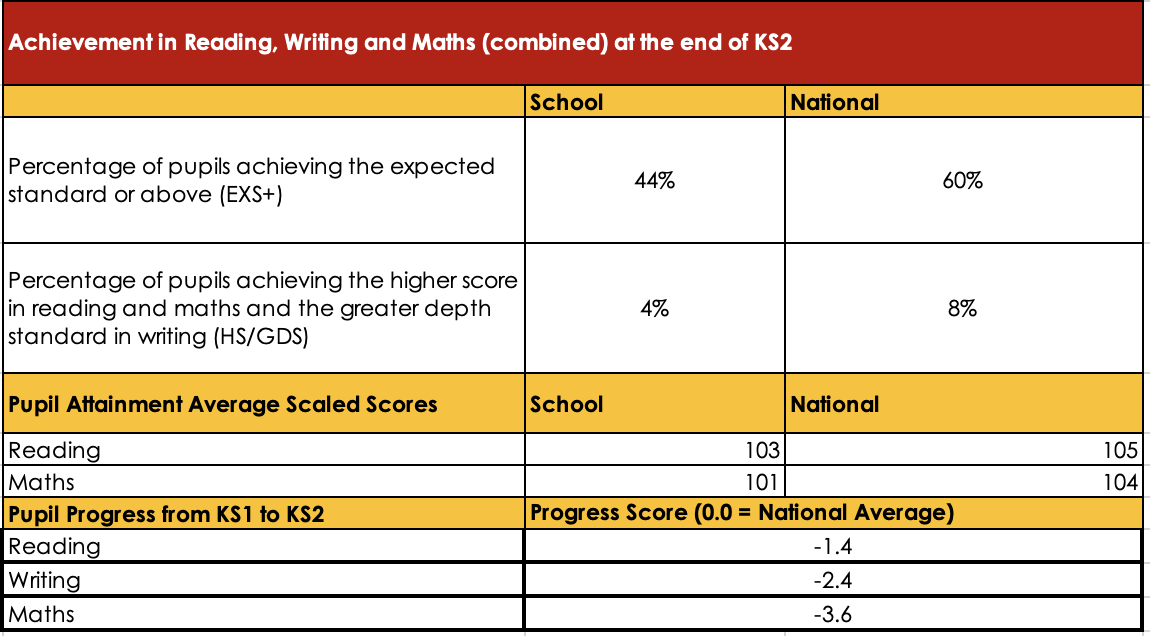
What Is A Scaled Score?
Each child is given a scaled score as a number. This is based on his/her raw score – the number of marks he/she receives in a test.
Children may achieve a score of:
- Below 100, meaning they have not achieved the ‘expected standard’
- 100, meaning that they have reached the ‘expected standard’
- Above 100, meaning that they have exceeded the ‘expected standard’
In year 6 (KS2) scores range from 80 to 120. A child who reaches the expected standard (100 or above) is considered to be ready for the next stage of his or her education.
Why Use Scaled Scores?
Scaled scores help test results to be reported consistently from one year to the next. For example, if two children achieve the same scaled scores in different tests in different years, they will have the same level of attainment.
How will results be reported in year 6?
Most children in year 6 will have taken tests in maths, reading, and grammar, punctuation and spelling.
Your child’s end-of-year report will include their scaled score and clear confirmation as to whether they have met the national standard.
Some schools also took ‘sample’ science tests. However, these results will not be reported.
Should I be worried if my child does not meet the expected standard?
There is no reason to worry. The tests are designed to help identify where children may need extra support as early as possible.
Your child will also receive teacher assessment results which help to give a broader picture of how well they are doing.
If you have any concerns, please speak to your child’s teacher.
Where To Go For More Information
Contact the school
If you have any questions about changes to KS1 and KS2 assessments and what they mean for your child, please do not hesitate to contact the school.
External sources
The following sources may also be useful for further information:
Scaled scores at KS2, GOV.UK – STA
https://www.gov.uk/guidance/scaled-scores-at-key-stage-2
Department for Education Performance Tables
SIAMS
What is SIAMS? (Statutory Inspection of Anglican and Methodist Schools)
All Church of England schools undergo a Statutory Inspection of Anglican and Methodist Schools (SIAMs). The purpose of SIAMs is to evaluate the distinctiveness and effectiveness of a school as a church school. SIAMS explores ways in which each school’s theologically rooted Christian vision drives its work and enables the school to live up to its foundation as a Church school. It does so by seeking to answer six or (in the case of Voluntary Aided schools) seven Inspection Questions (IQs).
IQ1: How does the school’s theologically rooted Christian vision enable pupils and adults to flourish?IQ2: How does the curriculum reflect the school’s theologically rooted Christian vision?
IQ3: How is collective worship enabling pupils and adults to flourish spiritually?
IQ4: How does the school’s theologically rooted Christian vision create a culture in which pupils and adults are treated well?
IQ5: How does the school’s theologically rooted Christian vision create an active culture of justice and responsibility?
IQ6: Is the religious education curriculum effective (with reference to the expectations set out in the Church of England’s Statement of Entitlement for Religious Education)?
IQ7: What is the quality of religious education in voluntary aided and former voluntary aided schools, and in former voluntary controlled schools in which denominational religious education is taught?
SIAMS inspection focusses on the impact of the Church school's Christian vision on pupils and adults. This involves looking at the school’s Christian vision, the provision the school makes because of this vision and how effective this provision is in enabling all pupils to flourish. Church schools will employ a variety of strategies and styles appropriate to, and reflective of, their particular context in order to be distinctively and effectively Christian in their character and ethos. SIAMS inspectors, therefore, do not look for a set template of what a Church school should be like, but rather take the particular context of the school into account and base their evaluation on the outcomes rather than the process.
You can download and read our latest SIAMs report below, which was carried out in January 2026.
